
FastEmbed: Qdrant's Efficient Python Library for Embedding Generation
Nirant Kasliwal and Manas Chopra
·July 30, 2026

Data Science and Machine Learning practitioners often find themselves navigating through a labyrinth of models, libraries, and frameworks. Which model to choose, what embedding size, and how to approach tokenizing, are just some questions you are faced with when starting your work. We understood how many data scientists wanted an easier and more intuitive means to do their embedding work. This is why we built FastEmbed, a Python library engineered for speed, efficiency, and usability. We have created easy to use default workflows, handling the 80% use cases in NLP embedding.
Current State of Affairs for Generating Embeddings
Usually you make embedding by utilizing PyTorch or TensorFlow models under the hood. However, using these libraries comes at a cost in terms of ease of use and computational speed. This is at least in part because these are built for both: model inference and improvement e.g. via fine-tuning.
To tackle these problems we built a small library focused on the task of quickly and efficiently creating text embeddings. We also decided to start with only a small sample of best in class transformer models. By keeping it small and focused on a particular use case, we could make our library focused without all the extraneous dependencies. We ship with limited models, quantize the model weights and seamlessly integrate them with the ONNX Runtime. FastEmbed strikes a balance between inference time, resource utilization and performance (recall/accuracy).
Quick Embedding Text Document Example
Here is an example of how simple we have made embedding text documents. First, install FastEmbed:
pip install fastembed
Then, generate embeddings for a list of documents:
from typing import List
from fastembed import TextEmbedding

documents: List[str] = [
    "Hello, World!",
    "fastembed is supported by and maintained by Qdrant."
]
embedding_model = TextEmbedding()
embeddings: List[np.ndarray] = list(embedding_model.embed(documents))
These last 3 lines of code do a lot of heavy lifting for you: They download the quantized model, load it using ONNXRuntime, and then run a batched embedding creation of your documents.
Code Walkthrough
Let’s delve into a more advanced example code snippet line-by-line:
from fastembed import TextEmbedding
Here, we import the TextEmbedding class from FastEmbed. This is the core class responsible for generating embeddings based on your chosen text model. By default, it loads BAAI/bge-small-en-v1.5
documents: List[str] = [
    "passage: Hello, World!",
    "query: How is the World?",
    "passage: This is an example passage.",
    "fastembed is supported by and maintained by Qdrant."
]
In this list called documents, we define four text strings that we want to convert into embeddings.
Note the use of prefixes “passage” and “query” to differentiate the types of embeddings to be generated. This is inherited from the cross-encoder implementation of the BAAI/bge series of models themselves. This is particularly useful for retrieval and we strongly recommend using this as well.
The use of text prefixes like “query” and “passage” isn’t merely syntactic sugar; it informs the algorithm on how to treat the text for embedding generation. A “query” prefix often triggers the model to generate embeddings that are optimized for similarity comparisons, while “passage” embeddings are fine-tuned for contextual understanding. If you omit the prefix, the default behavior is applied, although specifying it is recommended for more nuanced results.
Next, we initialize the Embedding model with the default model: BAAI/bge-small-en-v1.5.
embedding_model = TextEmbedding()
The default model and several other models have a context window of a maximum of 512 tokens. This maximum limit comes from the embedding model training and design itself. If you’d like to embed sequences larger than that, we’d recommend using some pooling strategy to get a single vector out of the sequence. For example, you can use the mean of the embeddings of different chunks of a document. This is also what the SBERT Paper recommends
This model strikes a balance between speed and accuracy, ideal for real-world applications.
embeddings: List[np.ndarray] = list(embedding_model.embed(documents))
Finally, we call the embed() method on our embedding_model object, passing in the documents list. The method returns a Python generator, so we convert it to a list to get all the embeddings. These embeddings are NumPy arrays, optimized for fast mathematical operations.
The embed() method returns a list of NumPy arrays, each corresponding to the embedding of a document in your original documents list. The dimensions of these arrays are determined by the model you chose e.g. for “BAAI/bge-small-en-v1.5” it’s a 384-dimensional vector.
You can easily parse these NumPy arrays for any downstream application—be it clustering, similarity comparison, or feeding them into a machine learning model for further analysis.
Why FastEmbed is Useful
FastEmbed is built for inference speed, without sacrificing (too much) performance:
- Light: Unlike other inference frameworks, such as PyTorch, FastEmbed requires very little in the way of external dependencies. Because it uses the ONNX Runtime, it’s perfect for serverless environments like AWS Lambda.
- Fast: By using ONNX, FastEmbed ensures high-performance inference across various hardware platforms.
- Accurate: FastEmbed aims for better accuracy and recall than models like OpenAI’s
Ada-002. It always uses models which demonstrate strong results on the MTEB leaderboard. - Support: FastEmbed supports a wide range of models — dense, sparse, and multi-vector, including multilingual ones — to meet diverse use case needs.
We use BAAI/bge-small-en-v1.5 as our default TextEmbedding model:
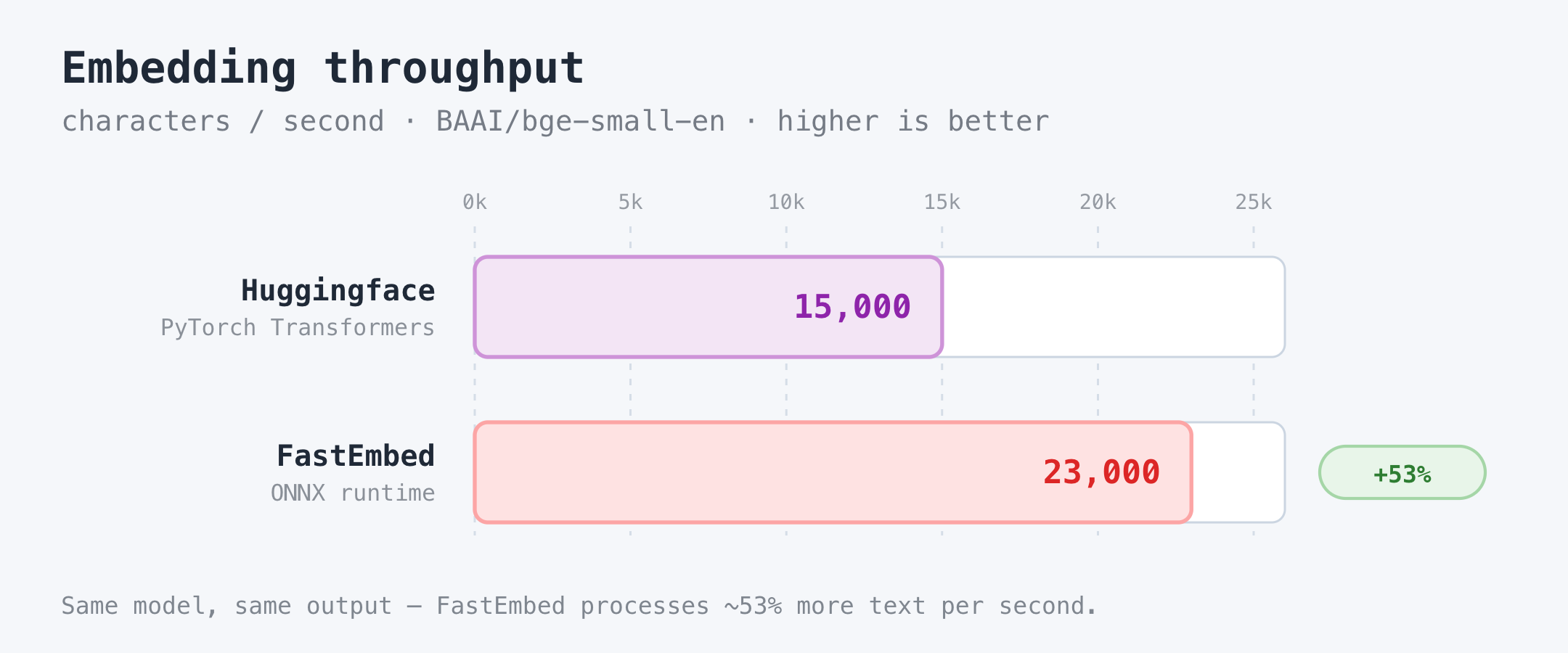
Under the Hood of FastEmbed
Quantized Models: We quantize the models for CPU (and Mac Metal) – giving you the best buck for your compute model. Our default model is so small, you can run this in AWS Lambda if you’d like!
Shout out to Huggingface’s Optimum – which made it easier to quantize models.
Light on Dependencies:
FastEmbed sets itself apart by maintaining a low minimum RAM/Disk usage. Unlike other inference frameworks, such as PyTorch, it requires very little in the way of external dependencies, and there’s no requirement for CUDA drivers to run on CPU.
This is intentional. FastEmbed is engineered to deliver optimal performance right on your CPU, eliminating the need for specialized hardware or complex setups, while still remaining agile and fast enough for production use.
ONNXRuntime and GPU Support: The ONNXRuntime gives us the ability to support multiple providers. FastEmbed’s default quantization targets CPU, but GPU acceleration is also available: install fastembed-gpu and set cuda=True (with device_ids to spread work across multiple GPUs) to run inference on GPU instead of CPU. FastEmbed also supports parallelizing inference across multiple CPU workers with the parallel parameter, and lazy model loading with lazy_load, to optimize throughput for large-scale indexing pipelines.
Current Models
FastEmbed has grown well beyond dense text embeddings. Today it supports:
- Dense embeddings – the default
TextEmbeddingmodel used throughout this article (e.g.BAAI/bge-small-en-v1.5, multilingual-e5, nomic-embed-text-v2-moe) - Sparse embeddings –
SparseTextEmbeddingmodels including BM25, SPLADE, and miniCOIL for exact keyword-style retrieval - Multi-vector embeddings –
LateInteractionTextEmbeddingmodels including ColBERT, ideal for rescoring and small-scale retrieval - Image embeddings –
ImageEmbeddingmodels including CLIP variants for visual and multimodal search - Rerankers –
TextCrossEncodercross-encoders to re-rank top-K results (e.g. ms-marco-MiniLM) - Postprocessing – MUVERA, for compressing multi-vector embeddings into single fixed-size vectors for fast first-stage search
Most of the models we support are quantized to enable even faster computation!
If you’re using FastEmbed and you’ve got ideas or need certain features, feel free to let us know. Just drop an issue on our GitHub page. That’s where we look first when we’re deciding what to work on next. Here’s where you can do it: FastEmbed GitHub Issues.
When it comes to FastEmbed’s default TextEmbedding model, we’re committed to supporting the best Open Source models.
If anything changes, you’ll see a new version number pop up. So, it’s a good idea to lock in the FastEmbed version you’re using to avoid surprises.
Using FastEmbed with Qdrant
Qdrant is a Vector Store, offering comprehensive, efficient, and scalable enterprise solutions for modern machine learning and AI applications. Whether you are dealing with billions of data points, require a low latency performant vector database solution, or specialized quantization methods – Qdrant is engineered to meet those demands head-on.
The fusion of FastEmbed with Qdrant’s vector store capabilities enables a transparent workflow for seamless embedding generation, storage, and retrieval. This simplifies the API design — while still giving you the flexibility to make significant changes e.g. you can use FastEmbed to make your own embedding other than the default TextEmbedding model and use that with Qdrant.
Below is a detailed guide on how to get started with FastEmbed in conjunction with Qdrant.
Step 1: Installation
Before diving into the code, the initial step involves installing the Qdrant Client along with the FastEmbed library. This can be done using pip. Wrap the package name in quotes so shells like zsh don’t try to expand the brackets:
pip install "qdrant-client[fastembed]>=1.14.2"
Step 2: Initializing the Qdrant Client
After successful installation, the next step involves initializing the Qdrant Client. This can be done either in-memory or by specifying a database path:
from qdrant_client import QdrantClient, models
# Initialize the client
client = QdrantClient(":memory:")  # or QdrantClient(path="path/to/db")
Step 3: Preparing Documents, Metadata, and IDs
Once the client is initialized, prepare the text documents you wish to embed, along with any associated metadata and unique IDs:
docs = [
    "Qdrant has Langchain integrations",
    "Qdrant also has Llama Index integrations"
]
metadata = [
    {"source": "Langchain-docs"},
    {"source": "LlamaIndex-docs"},
]
ids = [42, 2]
Step 4: Creating a Collection
Qdrant needs to know the size and distance metric of the vectors it will store before you can add anything to it. Since FastEmbed determines the vector size for a given model, you can ask the client for it directly instead of hardcoding it:
model_name = "BAAI/bge-small-en-v1.5"

client.create_collection(
    collection_name="demo_collection",
    vectors_config=models.VectorParams(
        size=client.get_embedding_size(model_name),
        distance=models.Distance.COSINE,
    ),
)
Step 5: Adding Documents to the Collection
With the collection created, wrap each document in models.Document, telling Qdrant Client which model to embed it with, and upload the vectors, payload, and ids together:
metadata_with_docs = [
    {"document": doc, **meta} for doc, meta in zip(docs, metadata)
]

client.upload_collection(
    collection_name="demo_collection",
    vectors=[models.Document(text=doc, model=model_name) for doc in docs],
    payload=metadata_with_docs,
    ids=ids,
)
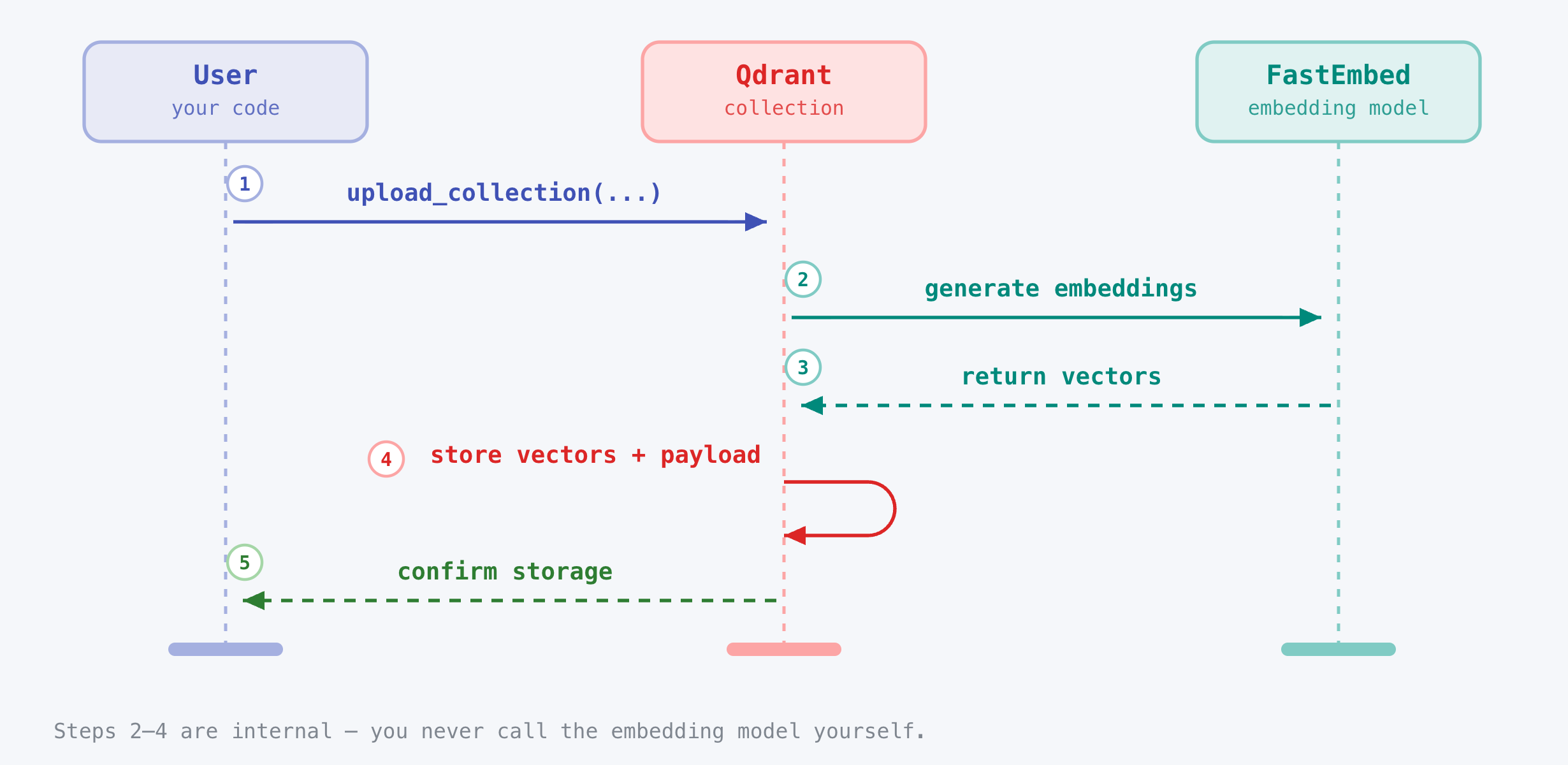
Inside this call, Qdrant Client uses FastEmbed to generate the text embeddings and upload them to the collection along with the payload. This uses the model you specified: BAAI/bge-small-en-v1.5
Step 6: Performing Queries
Finally, you can perform queries on your stored documents. Wrap the query text in models.Document the same way, and use query_points to search:
search_result = client.query_points(
    collection_name="demo_collection",
    query=models.Document(text="This is a query document", model=model_name),
).points
print(search_result)
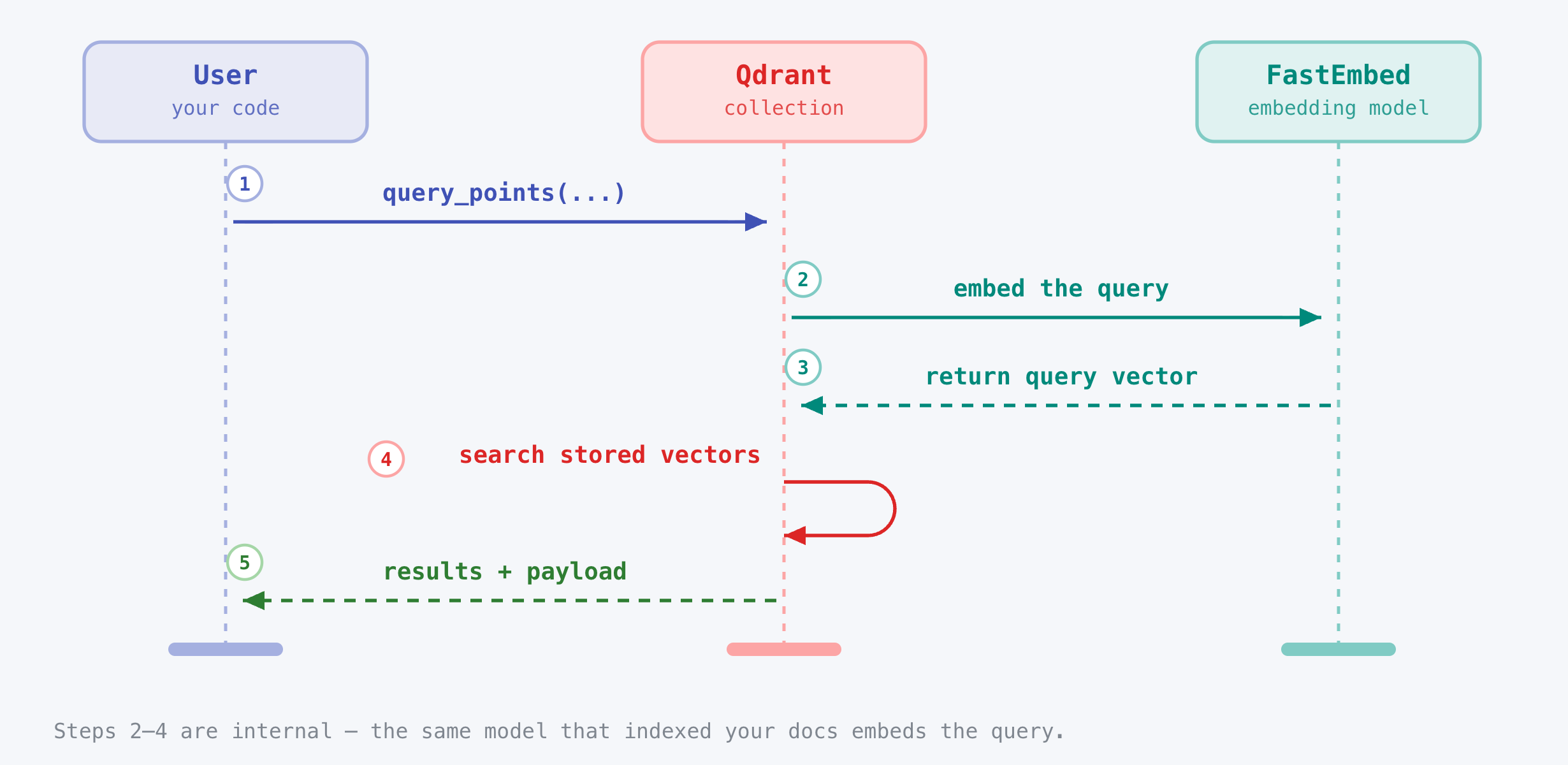
Behind the scenes, we first convert the query document to an embedding and use that to query the vector index.
By following these steps, you effectively utilize the combined capabilities of FastEmbed and Qdrant, thereby streamlining your embedding generation and retrieval tasks.
Qdrant is designed to handle large-scale datasets with billions of data points. Its architecture employs techniques like binary quantization and scalar quantization for efficient storage and retrieval. When you inject FastEmbed’s CPU-first design and lightweight nature into this equation, you end up with a system that can scale seamlessly while maintaining low latency.
Summary
If you’re curious about how FastEmbed and Qdrant can make your search tasks a breeze, why not take it for a spin? You get a real feel for what it can do. Here are two easy ways to get started:
Cloud: Get started with a free plan on the Qdrant Cloud.
Docker Container: If you’re the DIY type, you can set everything up on your own machine. Here’s a quick guide to help you out: Quick Start with Docker.
So, go ahead, take it for a test drive. We’re excited to hear what you think!
Lastly, If you find FastEmbed useful and want to keep up with what we’re doing, giving our GitHub repo a star would mean a lot to us. Here’s the link to star the repository.
If you ever have questions about FastEmbed, please ask them on the Qdrant Discord.